
The best portable power banks in the US for staying charged on the go | Life and style

If you travel enough, you’ve been through this rite of passage: you show up to the airport with a low phone battery, but every charging station is occupied. The wiggly outlet you find in the floor only works if you twist your charger sideways. Stringing a cord to the only outlet in the restaurant is like setting up a tripwire for servers.
Your salvation? A portable power bank, which quickly resurrects your phone from a tiny battery pack, no outlet needed.
The best portable chargers can quickly recharge your phone and other gadgets multiple times, include a built-in cable so you never need to remember yours, and recharge quickly when you find the next outlet.
After testing 15 of the best power banks, here are the best ones you can buy in 2026 for every scenario.
At a glance
Why you should trust me
In 20 years of testing and reviewing consumer electronics, I’ve visited factories that make portable battery packs, observed the testing involved and cultivated a deep knowledge of various battery technologies. I also use them every day in my own life. As a content creator, I rely on power banks to power the phones, laptops and tablets that keep me in business. Years ago, I used to carry multiple batteries for trade shows and events, but modern models have improved so much that one bank can power all of my devices, even during a particularly draining day.
How I tested
To find the best portable power banks, I started by considering dozens of products, then gathering 15 of the most promising models to test based on their specs, pricing, and availability. My custom-built testing setup uses a fan as a “dummy load,” which allowed me to determine exactly how much power to draw. By monitoring power into and out of the bank, I was able to measure both charging speed and efficiency – how much power is lost to heat. To confirm these lab findings in a real-life environment, I also tested how effectively each power bank charges an iPhone 17 Pro and Galaxy S26 Ultra, two of the best smartphones right now.
The best portable power banks in 2026
Best overall portable power bank:
Anker Laptop Power Bank 165W

Anker
Laptop Power Bank 165W
from $104.99
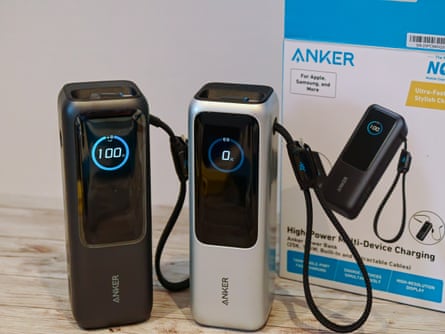
If you want just one power bank for every device and every scenario, this is the one to get.
Why we love it
I’ve taken more than 50 flights and traveled more than 100,000 miles with this power bank, which I’ve owned even before testing for this article. And after evaluating it beside 14 of its peers, I’m still convinced none do a better job.
With 165W of total output, it can efficiently charge multiple devices simultaneously without issue. I often plug in two phones, a Nintendo Switch 2, and sometimes even a laptop for a brief time. The power bank will not charge all of them fully from empty – which isn’t the point – but it will keep them topped off until I can get to a wall outlet. Ultimately, that’s all I need from a power bank.
The 25,000mAh capacity edges up against the maximum that you can take on a plane, where I routinely use it even when an outlet is available – it’s more reliable, and I don’t have to wedge my bag underneath to keep a charger from flopping out. It’s also perfect for short-haul or budget flights on planes that may not offer a power source.
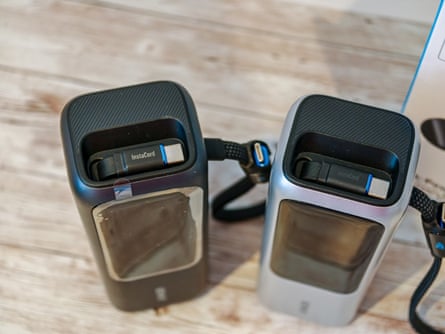
Anker includes two integrated USB-C cables measuring about 14in and 27in, as well as an additional USB-C port and a USB-A port. All three USB-C offerings support up to 100W and can charge another device or the power bank itself.
At 1.31lbs, the Anker Laptop Power Bank weighs about the same as a full bottle of Gatorade, and its side profile is similar in size to a dollar bill, but narrower.
After comparing a model I’ve owned for years to a new sample from Anker, I found my power bank still delivers 91% peak performance, which is impressive given its heavy use.
It’s a shame that … it’s not the absolute lightest, cheapest or fastest in this size class. But proven reliability, durability and usability matter more than spec sheet comparisons, which is why it remains our top pick.
Capacity: 25,000mAh
Peak power from a single port: 100W
Total power output: 165W
Ports: 3x USB-C (2 integrated cables, each up to 100W), 1x USB-A.
Weight: 1.31lbs
Anker
Laptop Power Bank 165W
from $104.99
Best budget power bank:
Anker Nano 5K (5,000mAh)

Anker
Nano 5K (5,000mAh)
from $26.99
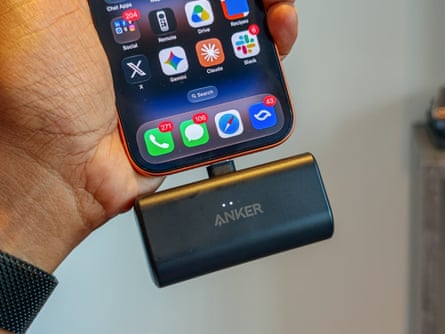
Tiny but mighty, the Anker Nano 5K is an inexpensive lifesaver that everyone should carry in their bag.
Why we love it
Most people just need a power bank to charge their phone, and just enough to top off after a long day. The Anker Nano 5K handily does that job at a size and price everyone will appreciate.
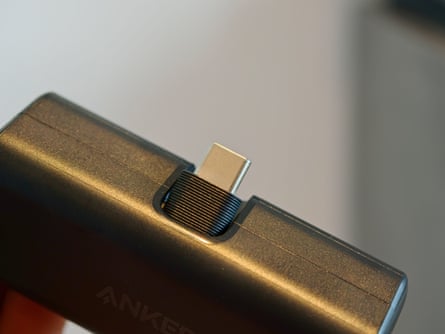
Roughly the size of a lipstick case, and available in a range of playful colors, the Nano will fit into most pockets. There’s no bulky cable, just a swiveling USB-C port that you can plug directly into your phone. It’s a brilliant universal design that works with newer iPhones (Series 15 and newer) and Androids alike, without relying on magnetic charging. There’s also a USB-C port on the side if you prefer plugging in a cable.
Its peak output of 22.5W is slower than what most modern phones can charge at, but still sufficient for most users in a pinch. On paper, the 5,000mAh capacity will fully charge both an iPhone 17 Pro and Galaxy S26 Ultra, but in my testing, it charged them from zero to 90% and 78%, respectively.
It’s a shame that … while it fits in a pocket, it’s chunky enough that you’ll probably prefer to toss it in a backpack or purse. The built-in USB-C plug is also incompatible with phone cases thicker than 0.19in, such as ultra-protective Otterbox Defender cases. If you use both USB-C ports at the same time, total power output drops to 15W.
Capacity: 5,000mAh
Peak power from a single port: 22.5W
Total power output: 22.5W
Ports: 1x swiveling USB-C connector, 1 USB-C port
Weight: 0.22lbs
Anker
Nano 5K (5,000mAh)
from $26.99
Best portable charger for laptops:
Anker Prime Power Bank

Anker
Prime Power Bank
from $179.99
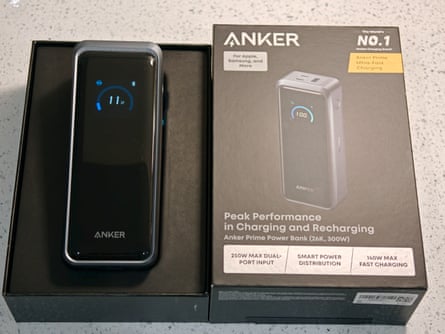
This is the pro-grade power bank for creators and other professionals who can’t afford to slow down.
Why we love it
Though its 26,250mAh capacity is similar to the Anker Laptop Power Bank, the Prime’s incredible output of 300W means that you can power two MacBook Pros at max speed and still have output left to charge a phone or another device. For many people, that’s overkill, but if you travel with a fleet of devices, or your family does, this is one device that can simultaneously charge them all at top speed.
An optional $100 charging base allows you to easily recharge it just by setting it down, plus provides two USB-C ports (140W and 100W) and a USB-A port. It’s a convenient way to keep it charged and ready to go.
When you do manage to deplete it, it’s also incredibly quick to recharge. You can connect two USB-C cables at once for a maximum speed of 250W, recharging to 50% in around 15 minutes and 80% in 40 minutes, whereas most power banks this size take almost two hours to recharge to full.
It’s a shame that … it’s expensive, and lacks the CCC marking needed to travel with it to China (see our explainer at the bottom of this article).
Capacity: 26,250mAh
Peak power from a single port: 140W
Total power output: 300W
Ports: 2x USB-C (2 integrated cables, each up to 100W), 1x USB-A.
Weight: 1.32lbs
Anker
Prime Power Bank
from $179.99
Best of the rest
Best portable power bank for travel:
Ugreen Nexode Pro

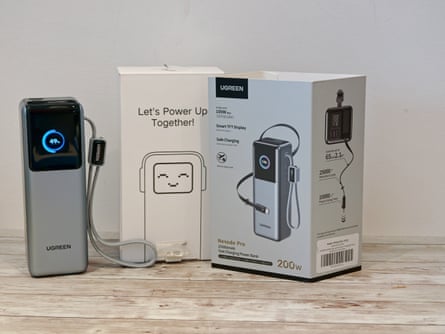
Lighter than power banks with the same 25,000mAh capacity, less expensive and certified for entry into China, the Ugreen Nexode Pro is a fantastic power bank to bring around the world with you.
Why we love it
The Ugreen Nexode Pro offers a fantastic balance of price and performance. It offers three USB-C ports with a maximum output of 140W (up to 200W total) and two integrated cables. Plus, it has a unique blue-green hue to it that definitely stands out against the more traditional black and grey we often see. The 25,000mAh capacity is more than capable of recharging multiple devices to full.
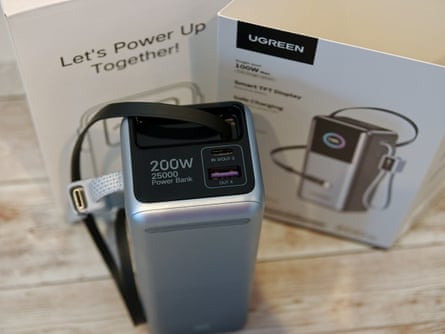
It didn’t make the final cut because … The TFT display is harder to read in bright conditions; the small font size makes it hard to read information such as remaining charge time, and navigating the menus on the screen feels sluggish. It also isn’t as effective as Anker’s Laptop Power Bank at managing the charge to multiple devices at once.
Capacity: 25,000mAh
Peak power from a single port: 100W
Total power output: 200W
Ports: 3x USB-C (2 integrated cables, each up to 100W), 1x USB-A
Weight: 0.79lbs
Travel notes: The only power bank I tested with CCC markings, making it the only one suitable for travel to all countries.
Best slim power bank:
Baseus Picogo AM52

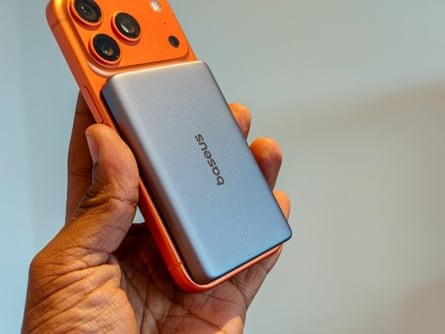
If I’m heading out for the evening and want to charge my phone while it’s in my pocket, this is the power bank I’m bringing along.
Why we love it
The best Apple MagSafe power bank also happens to be the best slim power bank, making the AM52 a gem even for Android owners. It’s unapologetically slim, lightweight and has a soft silicone finish on the side that magnetically latches onto your iPhone and charges wirelessly. The magnets are strong enough to keep it firmly attached to your iPhone, and the 10,000mAh capacity provides around 1.5 charges for an iPhone 17 Pro. You also get a 45W USB-C port, if you don’t want to charge wirelessly.
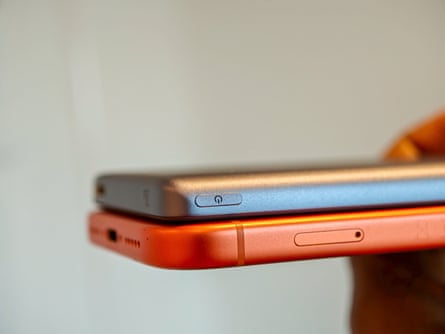
It didn’t make the final cut because … it gets pretty hot, though never too hot to use. Some power is lost to heat during all wireless charging, which is why all slim wireless chargers I’ve tested over the past five years struggle with this. The AM52 is no exception, and its silicone finish doesn’t seem to help, even if it does prevent scratches to your phone.
Capacity: 10,000mAh
Peak power from a single port: 25W
Total power output: 45W
Ports: 1x45W USB-C port, 1x MagSafe Qi2.2 25W magnetic wireless charger
Weight: .43lbs
Best power bank for Apple Watch and AirPods:
Statik SmartCharge Pro

Statik
SmartCharge Pro
from $99.99
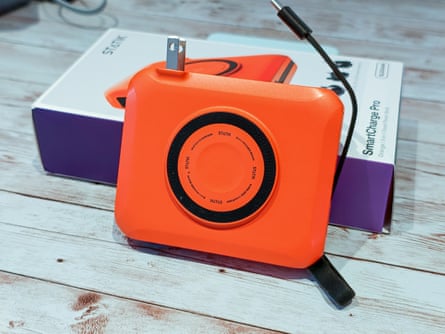
When your Apple Watch battery needs recharging, you need more than a USB-C plug: you need a magnetic charger. The Statik SmartCharge Pro has one built in, which will also wirelessly charge your AirPods. Add to that a built-in USB-C cable, USB-A port, USB-C port, and a standard wireless charger, and you have a true Swiss Army Knife of power banks. It even comes with UK, EU and AU adapters in the box so you can use it in hundreds of countries without an adapter.

It didn’t make the final cut because … Although it delivers 60W from either of the USB-C ports, the maximum wattage drops considerably when you plug in multiple devices, or charge the power bank and a device at the same time. And the bulky orange design isn’t for everyone.
Capacity: 15,000mAh
Peak power from a single port: 15W
Total power output: 60W
Ports: 2x USB-C (1 integrated cable), 1x USB-A, 2x wireless charger (1 phone, 1 Apple Watch)
Weight: .82lbs
Statik
SmartCharge Pro
from $99.99
What other products did the Guardian test?
-
Anker Nano Power Bank (30W, 10K)
-
UGREEN Nexode 25,000mAh 200W
-
Baseus Blade HD 100W (20,000mAh)
-
Anker MagGo Power Bank (Qi2, 10K)
-
Belkin BoostCharge Plus 10K
-
Nimble Champ Pro (20,000mAh, 65W)
-
Anker 737 Power Bank (24,000mAh, 140W)
-
Sharge Shargeek 170 (24,000mAh, 170W)
-
UGREEN Nexode 20,000mAh 100W
-
BMX SolidSafe Air 5K
-
Belkin BoostCharge Pro Qi2 5K
-
UGREEN Uno (10,000mAh, 30W)
-
EF ECOFLOW Rapid Pro Power Bank
-
Baseus EnerGeek GR11
-
Statik State Semi Solid State Power Bank
What you need to know about portable power banks
What should I look for in a portable power bank?
Don’t just look at which ports it has; look at their output. Most power banks have a combination of USB-C and USB-A ports across a range of charging speeds. For smartphones, 20W is usually enough for a relatively fast charge, but if you have a recent flagship phone, it probably supports up to 45W charging. For budget laptops, 30W is often enough, but if you have a premium laptop such as a MacBook Pro or Surface Pro, it may charge at up to 140W.
Also, check the maximum total wattage: some power banks with multiple ports will slow down one port if you connect multiple devices at the same time.
Capacity is measured in milliamp hours, or mAh – this is how much electricity the battery can store. For context, an iPhone 17 battery stores 3,692 mAh and a Samsung Galaxy S26 Ultra stores 5000mAh.
Unlike your phone, which you probably coddle thanks to its fragile screen, power banks get tossed in bags, dropped and typically endure more wear and tear. That means it’s worth looking at safety certifications, since a damaged lithium-ion battery can explode or catch fire. The key international certifications include UL (third-party), CE (Europe), CCC (China – more below), and FCC (USA). Companies such as Anker (ActiveShield) and Ugreen (Thermal Guard) also have proprietary systems that monitor temperatures and dynamically adjust power output to prevent overheating and fire hazards.
A good power bank should last between 300 and 500 full charge cycles before the battery health deteriorates to between 60% and 80%, which just means its capacity is diminished. If you’re using it for daily charging, this is roughly one or two years; for occasional use you may make it up to five years.
Finally, as with all products, look up the brand’s reputation. Several years ago, Aukey was the second-largest power bank seller on Amazon when it got busted faking its reviews and banned from Amazon. There is a reason some of the same brands appear on this list multiple times: they’re reputable.
Are all power banks suitable for flying?
No. The United States Transportation and Security Administration (TSA) prohibits flying with power banks larger than 100Wh (about 27,000mAh), and they must travel in carry-on bags, not checked luggage. All the models on this list fall below that limit.
Some airlines also impose additional restrictions, like prohibiting the use of power banks on board or banning them from overhead storage, so check with your particular airline before flying with one.
Other countries also have their own certifications and requirements. China, for instance, requires a China Compulsory Certification (CCC) label on power banks, and as I found out firsthand, will confiscate them at the security checkpoints if the label is missing. This new rule came into effect last year, and while companies have finally started adding the CCC marking on their power banks, not all of them have it yet.
Also note that some low-cost airlines limit you to 15lbs for your hand luggage, which some of the best power banks will consume a decent chunk of.
Should I buy a power bank with an integrated cable?
Yes, an integrated cable makes sense for most people. You never need to remember it, and you’ll never be caught in the maddening scenario of holding a power bank, a dead phone and nothing to connect the two.
But be aware that the integrated cable in a power bank may not provide the fastest speed a charger is capable of. In testing, I’ve noticed that the speed of integrated cables can vary wildly, especially if a power bank has more than one. Many don’t seem to offer the same performance you can achieve by plugging a separate high-performance cable into the provided USB-C port.
If you buy a charger with an integrated cable, consider experimenting with other cables if the speed disappoints you.
Other pieces you might enjoy from the Filter, the Guardian’s guide to buying fewer, better things: