
I’m addicted to checking my phone. Could a blocking device stop me? | Mobile phones
Wake up, 100 messages from group chat overnight about something – what? another assassination attempt; a village destroyed in Lebanon; the football result in England; the weather in Iran being manipulated; the pesticides causing lung and bowel cancer, so everyone who eats salads is now at risk of cancer; meditate for 20 minutes, then fire up x.com, a place I thought I’d never want to revisit, with its carnival barkers and supplement salesman, and have you seen the Lego thing calling Trump a paedo?, you gotta see the Lego thing, and this is before my first coffee, yet x.com is the coffee and the tea, whatever Elon has done to the For You algorithm is evil genius, it’s like the global collective id, nasty and funny and addictive and compelling – like gawking at a car crash, like soaking in a hot bubble bath of anger, and memes, and geopolitical dramas, and Trump, Trump, Trump – soaking in Trump, and then, For Me (just as Elon promised).
So begins the circuit around my phone, that goes all day and night, around the tiny screen with its icons (when a born-again Christian once told me he had favourite icons, for a long time I thought he meant apps, not pictures of the Virgin Mary). I started to feel like I was in Canberra, on one of those enormous roundabouts, rotating between the icons – not Joseph, not Jesus, but X and WhatsApp and TikTok and even LinkedIn for Christ sakes – round and round from one app to the next, just checking, checking in case something is happening. I watched tiny videos and maybe, occasionally, got distracted by the novel I am meant to be writing, which is due on 31 July. But the novel is boring, just a static Word doc on a screen, it’s not giving; it’s taking hard work. So I spend six minutes with my novel, and then it’s time to go back to my phone, to circle the roundabout visiting all my icons again, like a demented Stations of the Cross, because I can’t focus, I just can’t focus on work right now when there is so much good scrolling to do …
Clearly, this had to stop or I would become deranged and my novel wouldn’t get finished by 31 July.
But what could break the hold of a phone that seemed more and more addictive every day?
Then, while listening to a Guardian podcast (on my phone) I came across an author talking about a device that locked her phone and gave her her time and attention span back.
I had tried apps to lock my phone before, but somehow having them embedded in the phone itself was like placing a piece of fruit in a box of chocolates. Sure you go in there to retrieve the fruit, but you end up distracted by the chocolates. Before you know it, the chocolates have been eaten! The fruit, of course, remains untouched and rotting.
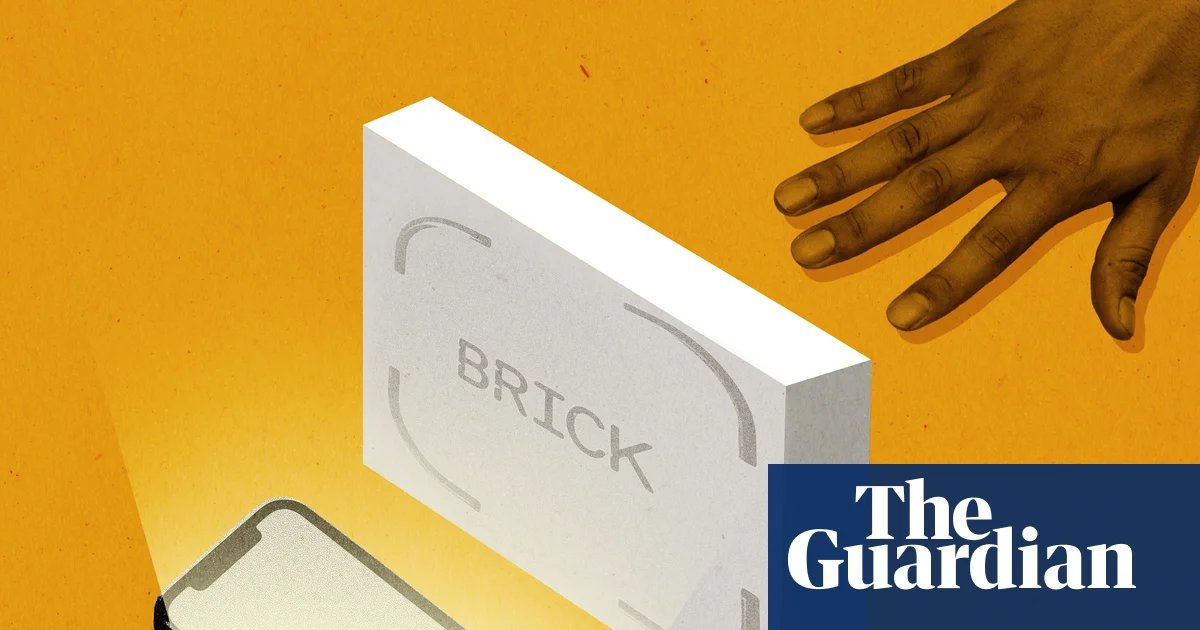
I needed an external device to lock my phone. This author was talking about something called Brick ($59US; £54 or $120 AUD including postage), a small plastic puck that you place on your phone which locks its most appealing apps. Hard!
The Brick and its cheaper rival Locked ($39USD; £32; $59AUD) use Near Field Communication (NFC) technology to block whatever apps you nominate. To unblock them, you have to physically return to the puck and tap it against your phone. You can set a timer – I set it for one or two hour blocks when I want to focus on my novel – and if you try to unBrick beforehand, it asks you if you want to have a life, or if you want your phone back. That prompt is enough to make me affirm that, yes, I want a life.
What Brick understands, and what every app-based screen time limit fails to grasp, is that the problem is not information or intention. I already knew I was using my phone too much. The problem is friction, or rather the total absence of it. Digital guardrails collapse the moment you need them most: one tap and you’re back on Instagram. Brick makes that tap a physical hurdle.
Using the Brick at night has been transformative. The hours I was losing in the roundabout, I now spend reading, thinking and occasionally just sitting in silence.
The novel is moving again and I can focus in longer and longer increments.
The algorithm doesn’t get me after 8pm any more, and it turns out the algorithm, deprived of its evening session, has less purchase on me during the day too.
Brick hasn’t cured my addiction, but it has restored the thing addiction most destroys, which is the moment of pause between impulse and action.