Yassmin Abdel-Magied: ‘I can be someone new here; I can choose who I want to be’ | Australian books
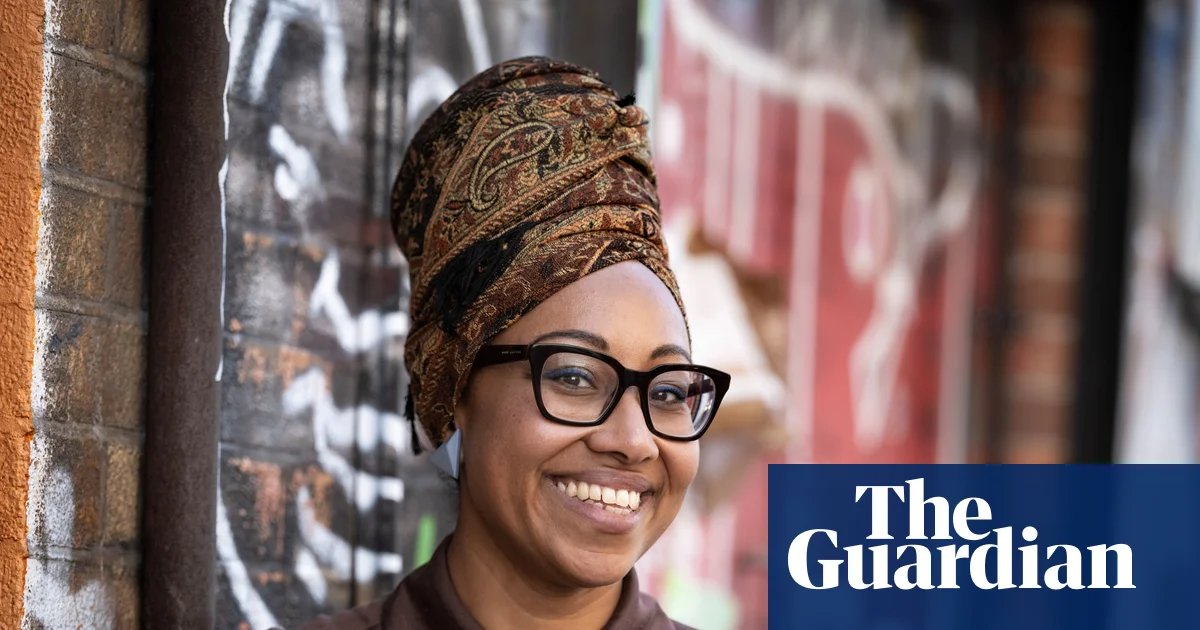
Of course London has its problems, but mornings like this – bright sunshine, blue skies, the first properly hot day of the year – make a persuasive case for its being the greatest city in the world. Yassmin Abdel-Magied doesn’t need convincing.
She is a “big defender” of the English capital, her home since 2017, she tells me soon after we meet up on Brick Lane. “A lot of people love to hate on London, but I’m like no-no-no,” she says, laughingly finger-wagging. “I’m not having any of that around me.”
It has just gone 10am on a Wednesday in early April. Abdel-Magied and I have already shed our jackets ahead of our planned journey across east London.
The prompt for our meeting is At Sea, Abdel-Magied’s ambitious new novel, and her first foray into adult fiction. But her guided tour of the spots that made her feel so welcome here in London, plus the looming 10th anniversary of her move, can’t help but cast our conversation back to the circumstances of her departure from Australia – a “painful chapter”, she tells me later, but not one that defines her. “And that’s something I’ve worked really hard on.”
In 2016, Abdel-Magied was a twentysomething social advocate and media personality on the rise, recently recognised as a Young Queensland Australian of the Year and gaining a national profile as presenter of Australia Wide on the ABC. By early 2017, however, Abdel-Magied had been made a target in Australia’s increasingly bitter culture wars – for her views on Islam, feminism and identity politics, and for having the temerity to speak out as a young Black Muslim woman.
After making a Facebook post on Anzac Day, invoking “lest we forget” for refugees in offshore detention and people in Palestine and Syria, Abdel-Magied faced an intense backlash from sections of the media and government. Months later, she moved to London.
“It was wild to observe,” Abdel-Magied says. “People kept being like, ‘Oh, it’ll blow over,’ and it never did.”
Despite the attacks and threats on her safety, she had not been actively looking to leave Australia, she tells me as we make a quick pit stop at her coworking space to drop off her bag.
Instead she was seduced by London on a work trip that summer. For the entire week, the weather was brilliant, just like today. (“I was fooled,” she adds ruefully.) Even Londoners seemed friendly, relative to the hostility and opinions she was facing in Australia.
“My thinking was, ‘I can be someone new here; I can choose who I want to be,’” Abdel-Magied says, leading me to her desk.
Post-it notes on the wall outline future projects; one reads “Betrayal”. Below them, her published works are neatly arranged, including the essay collection Talking About a Revolution, the middle-grade fantasy Silverbrook and two novels for children.
At Sea is the newest addition to the shelf, and Abdel-Magied’s seventh book. It follows Zainab, a Muslim woman working on an offshore oil rig who has just been awarded her dream job of head of drilling operations, only to be undermined by her all-male team. When Zainab discovers an apparent issue with the rig, she must determine if she is being disrespected, or if they are all in peril.
The novel is pacy like a thriller, with a tough-as-nails protagonist in an isolated setting and intelligent observations about group dynamics and being an outsider. Abdel-Magied drew from her own experience of working as a mechanical engineer on offshore rigs before moving into media and social advocacy.
She wanted to represent the reality of being at the mercy of the majority, she says, whether on a rig or in any other gendered space. “You can have all these nice ideas about how things should be, but when you’re in the middle of the ocean with a bunch of men, the rules are different,” she says. “I’m not saying that’s right – but I wanted to reflect it for what it was.”
At least those on the rigs were honest and upfront about it being “a man’s world”, Abdel-Magied says.
In London, Abdel-Magied found she did not have to change to fit in. “All the sharp edges about me that were causing me problems in Australia were things that people valued here,” she says, leading us back into the sunshine.
“Certainly, when I first moved, I was like, ‘This place is going to save me.’”
We are making our way down Redchurch Street, frequently named as one of the city’s coolest streets; Abdel-Magied lived around the corner for her first few years here.
Even in that time, “almost everything’s changed”, she says, drawing my attention to the chi-chi boutiques, branded street-art and other signs of rampant gentrification.
When she first moved, it was more of a “village environment”, Abdel-Magied tells me. She made her base Allpress cafe, befriending all the staff and starting every weekend there.
Abdel-Magied is the only person I’ve ever met who has made genuine friendships from a coworking space, but I shouldn’t be mistaken, she says, warmly: “I can deploy unfriendliness when required.”
As we stroll through Arnold Circus, a quiet, leafy street with mid-rise blocks arranged around a central bandstand, Abdel-Magied tells me about its history as London’s first-ever social housing project.
“The idea of the design was that everyone got to see green out of their window,” she says, as a rogue ring-necked parakeet darts overhead.
However, Abdel-Magied concludes – briefly stopping in her tracks “for the drama” – “like any gentrification” the original residents who were pushed out for the improvements never got to return and experience the benefits.
Since 2021 Abdel-Magied has also had stints living in Paris, on a writer’s residency funded by the Australia Council, and Leeds, writing for the British soap Emmerdale, set in Yorkshire.
Australia, however, Abdel-Magied speaks of with polite uninterest, as though it is a former friend she has no desire to reconnect with.
The ugliness she saw in her final year altered her view for ever, and not just of Australia, Abdel-Magied tells me as we wait to cross the road on to Goldsmiths Row, a shaded stretch that will lead us straight to London Fields. “I’ve often described it as completely shattering my understanding of how the world worked.”
Growing up in Brisbane, Abdel-Magied was in an overwhelmingly white world and the first-ever Muslim at her school of 2,500 pupils. She was always conscious of structural inequity and the ways in which she was disadvantaged – but she’d been led to believe that, by being a model minority, “I could stay one step ahead of it,” Abdel-Magied continues. “Obviously, that wasn’t true – and I had to figure out a new story, and a new way through, without giving up.”
For a long time after the months-long attack – predating her Anzac Day tweet, Abdel-Magied points out – she was angry.
Now Abdel-Magied looks back on it as a “particularly painful chapter”, but one that sharpened her self-trust and forward path: “I don’t think I would be the person I am today if it hadn’t happened.” She credits her faith, and wise counsel from people she won’t name who are also in the public eye, with helping her to see it as a “clarifying process”.
Abdel-Magied recalls her mother suggesting that she look for the lesson that Allah was trying to teach her, and what she was being “prepared for”.
Does she know now what the lesson was? Abdel-Magied shrugs. “Maybe it was just preparing me for a different life,” she says, stepping aside to allow a mother with a grouchy toddler to overtake us. “There was no way I would have left Australia [otherwise], I loved Australia.”
Abdel-Magied is quick, and correct, to call me out on my glib expression of sympathy. She does not miss Australia: “It was a love that shielded a lot of truth from me. Any kind of engagement that I have with it now is far more clear-eyed, and I think that’s quite a gift.”
She has sought to apply that perspective and understanding to her writing, she adds, as we turn on to Broadway Market. “I’m obsessed with those kinds of human dynamics.”
We’ve reached London Fields, and it’s seeming like the first day of summer. Those like us, lucky to be able to escape our desks, are making the most of the sunshine, strolling with iced coffees or sitting on the grass; some optimists on the public gym even have their shirts off.
A passing cyclist accosts Abdel-Magied like an ardent fan: “Can I have your autograph?” He turns out to be a friend, who reiterates his invitation to her to go swimming in the Serpentine River before speeding away. (How much did she pay him, I ask? “Literally, all my savings,” she jokes.)
On such an idyllic day, with London ours for the afternoon, Australia and that saga 10 years ago seems like a distant memory.
“I have moved past that story … I have built a whole new life,” Abdel-Magied says. After a hug goodbye, we part ways so that she can go and enjoy it.